


Bebefinn Birthday Party: Game
The Pinkfong Company
Birthday-themed games for young children often promise a cheerful way to play, but the useful question is whether the activity gives a child something clear to do rather than simply filling the screen with noise. My experience with Bebefinn Birthday Party is that its strongest idea is the party-making routine: the child moves through familiar birthday moments such as preparing a cake, adding decorations, and joining in with party songs. That focused structure makes it approachable for preschool-age players who may not yet be ready for rule-heavy games.
Published by The Pinkfong Company, this free educational game is aimed at Everyone and runs on Android devices using version 8.0 or later. It has reached over 500 thousand installs, while its average rating sits at 3.2 from around 560 ratings. Those figures suggest a game with a real audience but also a mixed reception, which matches my impression: the presentation is friendly and easy to understand, yet the experience is intentionally simple and may feel limited if you expect a larger collection of activities.
Birthday preparation is the central learning-friendly activity
The main capability is not competition, problem-solving, or exploration across a large world. It is guided pretend play built around making a birthday celebration. A child can take part in the visual steps of preparing a cake, decorating the setting with balloons, and enjoying songs associated with the party. That narrow focus is important because it keeps the interaction within a theme children already recognize from everyday life.
I see this as a gentle introduction to sequencing. A child is encouraged to think about what belongs in a celebration and what might happen next. The game does not need complicated instructions to create that feeling. Cake preparation leads naturally into decoration, and decoration leads naturally into the musical part of the event. Even when the actions are playful rather than academic, the order of activities gives the session a loose beginning, middle, and end.
The real strength is its low-pressure party routine. There is no need for a child to understand points, opponents, timers, or difficult controls before enjoying it. That makes it more suitable for a short supervised play session than for a child looking for a deep game with increasing challenge. I would describe it as an interactive birthday scene with game elements, rather than a traditional game built around winning.
Related News






The educational value also comes from recognition and participation. Birthday objects, decorations, and music are easy subjects for a young child to identify. Parents can use the activity as a starting point for simple conversation: What should go on the cake? Which decoration would you choose? What happens at a birthday party? Those questions turn the screen session into shared play instead of leaving the child alone with a sequence of taps.
What the child actually does during a session
In practice, the appeal comes from visible cause and effect. The child performs a party-related action and sees the scene become more festive. That immediate response matters for younger players, because a long explanation or delayed reward can quickly lose their attention. The birthday theme provides a consistent visual reason for each action, so the activity feels connected rather than like a collection of unrelated mini-games.
The cake element is especially useful for children who enjoy creative routines. Rather than asking them to solve an abstract puzzle, it gives them a familiar object to work on. The balloon decoration adds another layer of visual choice and helps the party setting feel active. The songs then change the mood from preparation to celebration, giving the session a recognizable finish.
Gallery
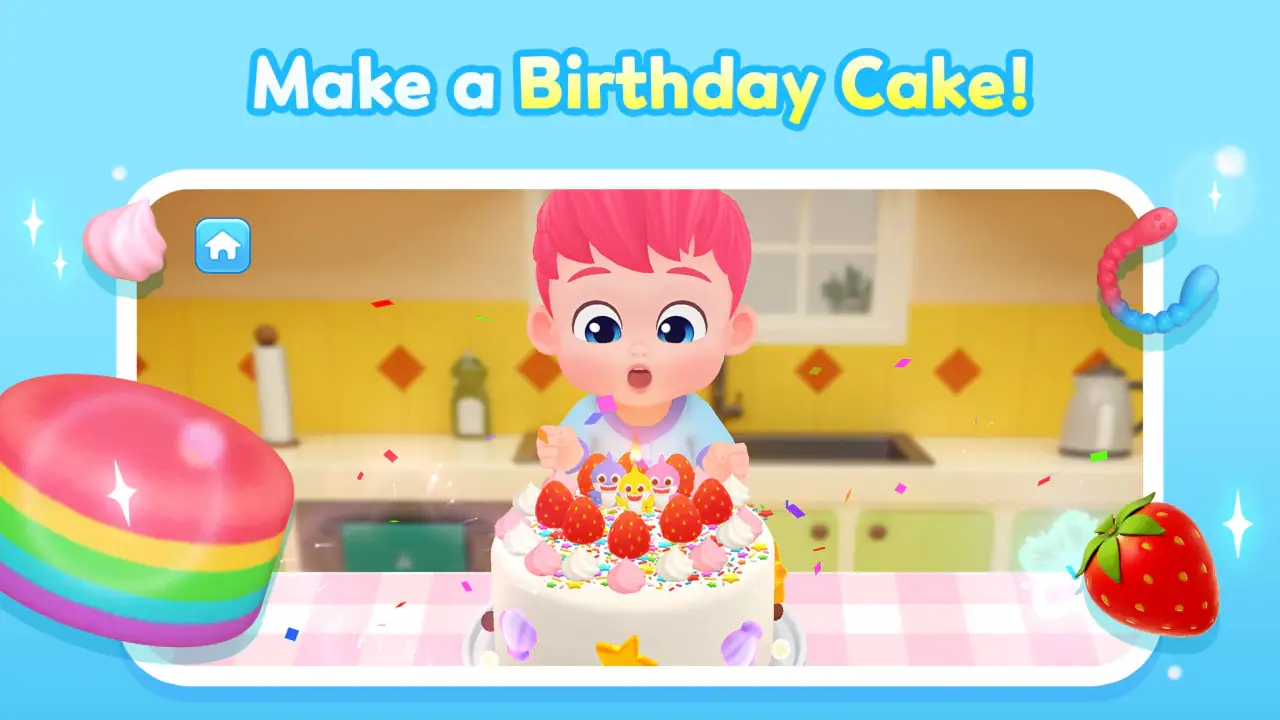
I would not install it expecting detailed cooking instruction or meaningful artistic tools. The cake is part of pretend play, not a recipe lesson, and the decorations serve the party atmosphere rather than teaching design principles. That distinction helps set the right expectation. Its educational character is informal: it supports attention, recognition, ordering, and participation through a birthday scenario.
For a parent, one practical advantage is that the theme explains itself. You do not need to invent a story before handing it to a child. You can say, “Let’s get the party ready,” and the child already understands the basic idea. If the child is familiar with the Bebefinn characters or the style associated with The Pinkfong Company, that familiarity may make the invitation to play even easier.
How I would use it with a young child
I would keep the first session short and sit nearby rather than treating it as an unattended activity. The first few minutes are a good opportunity to see whether the child understands the visual prompts and whether the songs hold attention. If the child starts tapping randomly, I would guide the conversation back to the party: choose an item, notice the change, and ask what should happen next.
A useful routine is to let the child lead the decoration while the adult narrates the sequence. For example, the adult can describe the cake preparation, pause while the child chooses or completes an action, and then celebrate the finished setting. This turns a simple interaction into a small language exercise without making the game feel like homework.
Another practical use is as a transition activity before a real birthday event. A child who is nervous about guests, food, or unfamiliar routines may enjoy rehearsing the idea of a party in a safe, colorful setting. I would not claim that the game prepares a child for every social situation, but it can provide a familiar conversation point before attending a celebration or planning one at home.
The music can also be used deliberately. Instead of leaving it playing in the background, I would ask the child to listen for the change from preparation to celebration and then talk about how the mood feels. That makes the song portion more interactive. If the child becomes overstimulated, lowering the session length or moving on to a quieter activity is sensible; a party theme is naturally energetic, and not every child responds well to repeated musical stimulation.
The best everyday scenario for this game
The clearest use case is a short indoor activity on a day when a child needs something familiar and easy to start. Imagine a parent preparing dinner while a preschooler wants attention but cannot join the kitchen safely. A brief birthday-party session can give the child a contained activity, especially if the parent checks in and asks about the cake or decorations between tasks.
It also fits a quiet afternoon after a birthday celebration. The child can revisit the idea of a party without needing extra toys, ingredients, or preparation. In that setting, the game works best as a prompt for talking about what happened earlier: who attended, what decorations were visible, and which part of the celebration the child remembers.
For siblings, the experience may work when one child is still developing basic interaction skills and the other is willing to narrate or take turns. I would establish the turn-taking rule before opening the game, because a simple activity can still cause arguments when both children want to control the screen. The game itself should not be expected to teach cooperation automatically; the adult’s structure is what makes that use successful.
It may also suit a child who is just beginning to use a touchscreen. The recognizable objects and straightforward theme are less intimidating than a game that begins with a complicated menu or a large map. Still, I would watch for accidental taps and frustration. A young child may understand the party idea but not yet have the fine motor control needed for every interaction.
Where it differs from usual children’s game alternatives
Compared with early-learning apps built around letters, numbers, matching, or structured puzzles, this game is more imaginative and event-based. It is not the better choice when a parent wants focused practice with counting, phonics, memory, or measurable progression. Those alternatives usually offer clearer repetition and a more direct learning target.
Compared with open-ended drawing or dress-up apps, the birthday-party experience has a stronger sequence. The child is not simply given a blank space and asked to create anything. The party setting provides a destination, which can help children who enjoy guidance but may confuse children who want complete freedom.
Compared with video-only children’s entertainment, it asks the child to participate. That is a meaningful difference: preparing and decorating can create more active attention than passively watching a birthday song. On the other hand, a video may be easier for a tired child who only wants to relax, while this game works better when the child is ready to touch, choose, and respond.
Compared with larger children’s game collections, its advantage is focus rather than variety. A broad collection may keep a child occupied longer by switching between many themes, but it can also make the experience less coherent. Here, the birthday setting is immediately understandable. The trade-off is that children who quickly exhaust one theme may ask for another app sooner.
Important trade-offs before installing
The first limitation is depth. The party concept is pleasant, but it does not appear designed to challenge an older child or provide a long-term mastery path. If your child wants levels, goals, puzzles, or a sense of accomplishment that builds over time, this may feel more like a brief activity than a complete game.
The second issue is the mixed store reception. An average rating of 3.2 indicates that the friendly theme does not work equally well for everyone. I would interpret that as a reason to keep expectations modest, not as proof that the game is poor. The experience depends heavily on whether the child enjoys birthday pretend play and whether the available interactions feel substantial enough for that child.
The game is free to install, but in-app purchases range from $8.99 to $109.99 per item. That is the detail I would pay closest attention to before letting a child play independently. A parent should review the purchase setup on the device and avoid assuming that “free” means every part of the experience is available without additional spending. The wide range makes adult oversight particularly important.
There is also a difference between a game being rated Everyone and being ideal for every child. The age rating makes it broadly suitable from a content perspective, but younger children may still need help with navigation, turn-taking, or understanding what to do next. An older child may find the same simplicity boring. Age suitability and engagement are not identical.
Device compatibility is straightforward for relatively recent Android phones and tablets, since the game requires Android 8.0 or later. Before installing it on an older family device, I would check the operating-system version. That small check prevents the common disappointment of planning a child’s activity only to discover that the device cannot run it.
Small strategies that make the experience better
My first tip is to use the game as a conversation loop rather than a digital babysitter. Ask the child to predict the next party step before tapping. This adds a simple memory and sequencing challenge without changing the app or demanding that the child read instructions.
My second tip is to connect the virtual cake to a real-world activity. After playing, a child could draw a cake, arrange paper balloons, or help place napkins for a family celebration. The game then becomes a visual prompt for hands-on play. This is more valuable than repeating the same screen actions until the novelty disappears.
My third tip is to use the music as a stopping signal. Rather than ending abruptly, let the celebration song mark the close of the session, then put the device away and name what the child completed. This gives the activity a predictable finish and may reduce arguments about stopping, especially when the child knows that the party has reached its ending.
A fourth useful approach is to observe which part holds attention. If the child enjoys cake preparation but ignores decoration, focus your conversation on the preferred element rather than forcing every part of the routine. If the songs are the main attraction, use them as a bridge into clapping, movement, or singing away from the screen. The game is flexible enough to support these extensions, but the adult has to create the connection.
Who gets the most from Bebefinn Birthday Party
I think this game is best for a young child who enjoys familiar celebrations, colorful pretend play, and short guided activities. It is particularly suitable for a parent who wants a simple birthday theme that can lead into conversation, drawing, singing, or preparation for a real event. Children who are beginning to explore tablet controls may also appreciate the clear subject matter.
It is less suitable for a child seeking academic drills, open-ended creation, or substantial challenge. I would choose a dedicated literacy or numeracy app for focused skill practice, a drawing app for unrestricted creativity, and a larger game collection for variety. I would also skip it if the family is not comfortable supervising in-app purchases or if the child becomes easily overstimulated by party music and bright celebratory scenes.
The current version is 1.7, and the game remains a specialized experience rather than an all-purpose children’s platform. That is not necessarily a weakness. A narrow activity can be exactly right when a child needs a familiar theme for ten quiet minutes. It becomes a weakness only when the parent expects enough variety to replace a broader collection of games.
My final view is positive but carefully limited: Bebefinn Birthday Party works best as a guided pretend-play break, not as a complete educational curriculum or a deep game. I would recommend trying it for a child who likes birthday scenes and responds well to visual routines, while keeping an adult involved and checking purchase controls first. Its cake, balloon, and song sequence gives the child a clear celebration to participate in, and that focused capability is the reason to install it.
FAQs for Bebefinn Birthday Party: Game
What is Bebefinn Birthday Party: Game?
Bebefinn Birthday Party: Game is a colorful children’s game centered on preparing and enjoying a birthday celebration with the Bebefinn characters. After exploring its activities, I found that it combines simple interactive tasks, music, decorations, party moments, and character animations in a friendly format designed for young children. The gameplay is casual and easy to understand, with no complicated controls or advanced gaming skills required.
Is Bebefinn Birthday Party: Game suitable for young children?
The game is primarily aimed at preschool and early-childhood players, especially children who already enjoy Bebefinn songs and animated characters. Its bright visuals, familiar birthday theme, simple touch interactions, and gentle pace make it accessible for younger users. Parents should still supervise play, particularly when children use a connected device, because age suitability can vary depending on the child’s reading ability, attention span, and comfort with mobile games.
Is Bebefinn Birthday Party: Game free to download and play?
The availability of free content, optional purchases, advertisements, or locked activities may depend on the version offered through the Android or iOS store and the user’s region. Before downloading, parents should check the store listing carefully for pricing information and in-app purchase details. It is also a good idea to review the device’s purchase restrictions, since children may be able to tap through menus without fully understanding payment-related prompts.
Does Bebefinn Birthday Party: Game require an internet connection?
The game may allow some basic activities to work after installation, but certain features can depend on an internet connection. Online access may be needed for downloading the application, displaying advertisements, restoring purchases, receiving updates, or loading additional content. Because requirements can change with updates, I recommend checking the official store description and testing the game in offline mode before relying on it during travel or in places with limited connectivity.
Are there parental controls or privacy concerns in Bebefinn Birthday Party: Game?
Parents should review the game’s privacy information and store permissions before allowing a child to play. Children’s games can include advertising, analytics, external links, or purchase options, even when the main activities are simple and family-friendly. Use the device’s parental controls to restrict purchases and limit access to unrelated content. If the game offers a parent section, adults should open it themselves and check the available settings before handing over the device.
Pros
- Bright
- cheerful visuals are appealing to preschool-aged children.
- Simple tap-based controls are easy for young players to understand.
- Birthday-themed activities encourage playful exploration and discovery.
- Familiar Bebefinn characters can make the game feel welcoming.
- Short activities suit children with limited attention spans.
Cons
- Some content may feel repetitive after several play sessions.
- The game offers limited challenge for older children.
- Parents may find the educational value relatively modest.
- In-app purchases or ads may depend on the current app version.
- Requires supervision if children are using a shared device.


